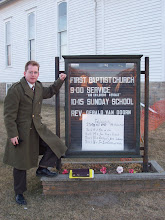
Recently, I filmed a day in my life here in Iraq-so I could show people the good we do as army chaplains. I have posted them up on my youtube site (www.youtube.com/aramaic12).
I have been able to do good here-in spite of myself. I know I am not the best chaplain in the world. I am an imperfect human being. But I have been able to touch soldiers lives. I am proud of what the United States Army has accomplished in Iraq. I ask that you would continue to pray for me-for all chaplains and soldiers and for the nation of Iraq as well.
Thursday, July 29, 2010

Freedom in Christ
"Stand fast therefore in the liberty wherewith Christ hath made us free, and be not entangled again with the yoke of bondage." (Galatians 5:1)
Today I am going to discuss:
- Freedom and what it is
- The Freedom we have in Jesus Christ and
- What we should do with the aforementioned Freedom
The "Liberty Bell" is inscribed with a Bible verse- Leviticus 25:10-which reads "Proclaim liberty throughout all the land unto all the inhabitants thereof." In his Gettysburg Address, Mr. Lincoln described the United States of America as "a new nation, conceived in Liberty, and dedicated to the proposition that all men are created equal." In Chaplain School our NCOs favorite cadence was "Some say freedom is free-but I tend to disagree. I say freedom is won through the barrel of a gun." Servicemen and women in the United States Armed forces fight to defend freedom. For centuries American soldiers have been the defenders of freedom. It was American servicemen who fought for freedom against the British during the revolutionary war. We fought against the tyrannical Nazi regime and the regime of Emperor Hirohito in the Pacific. We also fought against Communism in Korea and Viet Nam. When I was mobilized to Iraq in 2003 my orders said I was mobilized to join in "Operation Enduring Freedom." We are now here participating in "Operation Iraqi Freedom."
According to the very names of these operations-it is freedom that we are fighting for.
Some people don't believe "Freedom" is a good thing. Martial artist Jackie Chan stated that he believed that the Chinese people need to be controlled. He said, "I'm not sure if it is good to have freedom or not," he said. "I'm really confused now. If you are too free, you are like the way Hong Kong is now. It's very chaotic. Taiwan is also chaotic." He added: "I'm gradually beginning to feel that we Chinese need to be controlled. If we are not being controlled, we'll just do what we want." Another martial artist, Jet Li starred in a movie entitled "Hero." The theme of the movie was that a powerful government that oppressed the people and actually carried out atrocities was a necessary evil because it united the people-against their will-to become a more powerful nation.
Recently, an organization called "Freedom House" put together an annual report on Freedom around the world. Freedom House classified countries as "free," "partly free," and "not free" by a range of indicators that include fairness of elections, integrity of judges and independence of trade unions. In a report entitled "Freedom in the World 2010: Global Erosion of Freedom" they found hat liberty has declined in 40 countries but has gained in 16. Certain electorates actually voted in governments that have stripped them of their freedom and human rights. Examples include Russia-which is now no longer considered a "free country" and the Palestinian Authority-which elected the radical Islamic terrorist organization "Hamas" into power.
I learned to appreciate my freedom after I lived in Egypt when I was 19 years old. I have lived in a totalitarian police state when I lived in Syria. I have been followed by the Muhkhabart-the secret police and saw my Christian friends interrogated by secret police.
Our freedoms are fragile. Recently, freedom of speech and religion have been threatened by Islamic nations that have been offended by cartoon shows such as "South Park" and social networking websites such as "Facebook." To me it is very disturbing that both cable networks and these social networking sites have practiced censorship-why-because people were offended by what was said. They felt threatened by dialogue, debate and critical thought and were able to stifle free speech. Also, it is a disturbing trend were we find that it is permissible to mock and ridicule Christianity while at the same time questioning Islam is a crime.
Jesus said, "Ye shall know the truth, and the truth shall make you free." (John 8:32). Jesus also said, "I am the way, the truth and the life-no one comes to the Father but by me." I believe that the truth will hold its own. We need free speech so that people can think and question and discuss-so that the truth will be established. We must resist efforts of certain radicals –whether they be Atheists or Islamists-to stifle discussion and dialogue.
We have also see the trend-even in the United States were people are willing to sacrifice their freedoms in exchange for what they view as "security." However, once freedoms are lost-there is a terrible price in winning them back. Thomas Jefferson sated once that "the tree of liberty must be refreshed from time to time with the blood of patriots and tyrants."
There is such a thing as religious tyranny. We see this in places like Saudi Arabia and Iran. Sometimes the Puritans are portrayed as being religious tyrants. We see this in the world "puritanical" which basically means religiously oppressive. Certain Christians and religious people can be judgmental and legalistic. But while this is a type of religiosity-it is not the "religion pure and undefiled" as spoken of by James the Brother of Jesus. This "religious spirit" is not of God. We know this because Paul the Apostle stated, "Where the Spirit of the Lord is, there is liberty." (2 Corinthians 3:17).
What does it mean to be "Free"? What freedoms are we fighting for?
What is freedom? Freedom must mean to have the power of self-determination. Power means the ability to make people do what you want them to do-even if its against their will. I probably wouldn't pay taxes if I didn't have to. Freedom means the ability to freely choose your own life. This idea is found in the Declaration of Independence of the United States of America. According to the Declaration of Independence human being are endowed by their Creator with certain unalienable rights and among these are life, liberty and the pursuit of happiness. This is a profound truth-these liberties we have are not given to us by the Constitution nor are they derived from a Supreme Court-NO-these freedoms we have come from God.
(Sometimes people wonder if our ideas are really biblical or they are actually American concepts we read into the Bible. Once you read the Bible you see the ideas of the rights of the individual, justice and fair play and a government accountable to righteousness, the people and to God are not only biblical principles they are the principles upon which the United States of America was founded.)
It is important to have a proper understanding of Freedom. Certain people have sought for Freedom in sex and drugs and instead have found themselves in bondage.
God's commandments and his truth are not oppressive-they are liberating.
"Whoso looketh into the perfect law of liberty, and continueth therein, he being not a forgetful hearer, but a doer of the work, this man shall be blessed in his deed." (James 1:25)
Jesus Christ Offers us Freedom from Spiritual Bondage
We are all sinners and have committed sins in thought and deed. There are consequences to our sinful behavior. Jesus said whoever sins is a slave to sin.
"If the Son therefore shall make you free, ye shall be free indeed." (John 8:36)
It is hard for us to imagine what slavery is like. In a way that is a good thing. All we know about slavery is what we learn about slavery in America before the Civil War. In our perceptions we see African Americans working the fields and we also see horrific images of these slaves being treated in a very cruel manner. In ancient times slavery was seen as part of life. Of course, in ancient times-anyone could be a slave-it wasn't about race. While it seems very odd to us today-often slaves were very devoted to their masters and at times would give their lives to their masters. (This historical reality of slavery is portrayed in the series "Rome.") The philosophers Aristotle noted a slave mindset that many slaves had. He believed that certain people were suited only for slavery. The New Testament was written to a society where slavery was the norm. Paul emphasizes that Christ came for all men-slave and freeman. Paul also taught that Christ liberates us-he even sets the mind free! It was the principle of the value of every man and woman thought in the New Testament that eventually brought an end to the slave trade. (How Christians worked to put an end to the slave trade is seen in the movie "Amazing Grace" which is about the abolitionist Wilfred Wilberforce. However, the slave trade and "human trafficking" isn't yet history but is a modern evil.)
The ancient Israelites knew bondage when they were enslaved by the Egyptians and forced to-according to Scripture-to make bricks and to do all matter of work in the fields. Throughout their history they knew slavery again when they were enslaved by the Philistines and also to the Babylonians.
But what is it that Christ sets us free from?
"For the law of the Spirit of life in Christ Jesus hath made me free from the law of sin and death." (Romans 8:2)
Jesus liberates us from religious or legalistic bondage and also from our slavery to sin-and its consequence (which includes hellfire).
"But now being made free from sin, and become servants to God, ye have your fruit unto holiness, and the end everlasting life." (Romans 6:22)
What should we do with the Freedom we have in Jesus Christ?
"For he that is called in the Lord, being a servant, is the Lord's freeman: likewise also he that is called, being free, is Christ's servant." (1 Corinthians 7:22)
"For though I be free from all men, yet have I made myself servant unto all, that I might gain the more." (1 Corinthians 9:19)
"As free, and not using your liberty for a cloak of maliciousness, but as the servants of God." (1 Peter 2:16)
We use the freedom we have in Christ to help other people. Jesus said, "I, the Son of Man came not to be served-but to serve-and to give my life as a ransom for many."
The Call into the Wilderness
"I will woo her into the desert. I will make her to dwell in tents again."
Thousands of years ago, Moses left a life of luxury in Egypt and discovered God in the Arabian Desert. Later, he liberated Israel from slavery and brought the Israelites to Mount Horeb where the nation experienced an intimate encounter with God. For a sanctuary of worship, Moses erected a simple tent, called "the tent of meeting." This sanctuary was opened to anyone who sought the Lord (Exodus 33:7). Later, another tent sanctuary was erected that was known as "the Tabernacle." Only priests were allowed inside this Tabernacle. Afterwards, Israel settled in Canaan and built a Temple in Jerusalem. God spoke to the Israelites through the prophets. Scribes wrote down and copied writings that would later be compiled and become the Bible. Later, the written word of God was elevated above the spoken word of prophecy. The Scribes stifled the word of prophecy and finally silenced it (2 Corinthians 3:6). The prophets themselves prophesied that the day would come when there would be a famine, not of bread, nor of water, but of hearing the word of God (Amos 8:11-12). The Psalmist mourned, "Now we no longer see signs. There is no longer any prophet. Nor is there anyone among us who knows how long." (Psalm 74:9). After four hundred years of no word of prophecy, a prophet arose. The prophet emerged, not in the great Temple of Jerusalem but in the desert. This fulfilled the ancient prophecies. Isaiah prophesied that "Justice and Righteousness will come and dwell in the desert, there my people will find a peaceful habitation. Blessed will be those who allow their animals, their donkeys and oxen, to roam freely there."(Isaiah 32:15-20, 55:12-13). (In the Bible, "the wilderness" isn't just a barren or sandy desert. It refers to any land largely devoid of human habitation.) Hosea had spoken this word from the Lord to Israel, "Therefore, behold, I will allure her, I will bring her into the wilderness, and speak comfort to her…She shall sing there, as in the days of her youth, as in the day when she came up from the land of Egypt…in that day I will make a covenant for them with the beasts of the field, with the birds of the air, and with all the living things of the earth. Bow and the sword I will shatter from the earth, to make them lie down safely. I will betroth you to Me forever, yes, I will betroth you to Me in faithfulness, and you shall know the LORD" (Hosea 2:14-20). The word of Yahweh came to Jeremiah speaking to Israel and saying, "I remember you, the kindness of your youth, the love of your betrothal, when you went after me in the wilderness, in a land not sown. Israel was holiness to the Lord (Jeremiah 2:2-3)." Hosea, like Amos before him, describes Israel's journey through the wilderness as a time of spiritual idyll. Israel was then innocent and childlike, knowing nothing of the pagan gods and loyal to Yahweh whose presence was seen during the time of Moses in the pillar of cloud by day and a pillar of fire by night (Exodus 13:21-22). In Hosea 2:16, Yahweh says to his bride, "I am going to lure her and lead her out into the wilderness and speak to her heart…I will betroth you to myself forever, betroth you with integrity and justice with tenderness and love. I will betroth you to myself with faithfulness and you will come to know Yahweh." Jeremiah speaks of the wilderness saying, "I remember the devotion of your youth, how you loved me as a bride, following me in the desert, in a land unsown" (Jeremiahs 2:2-3). Through Hosea the Prophet, Yahweh spoke saying, "I have been Yahweh your God since the land of Egypt. I shall make you dwell in tents again" (Hosea 12:9).
After four hundred years of a famine of prophecy, the voice of God was heard again, not in the temple, but in the wilderness as had been foretold. There was a prophecy that a prophet like Moses would come (Deuteronomy 18:15-22). It was also prophesied that Elijah, who was a wonder-working prophet, would return from heaven and turn the hearts of the fathers to their children, and the hearts of children to their fathers, in order to avert the wrath of God (Malachi 4:5-6). There was a man sent from God. His name was John (John 1:6). John was descended from a priestly family. His father had officiated in the Temple (Luke 1:5-24; 57-80). However, John was raised in the wilderness, away from Jerusalem and its temple. As a child he was taken into the wilderness and there he stayed until he began preaching (Luke 1:80). He never visited a town or lived in a city.
The word of God came unto John the son of Zechariah in the desert. John baptized in the wilderness, and preached the baptism, a total submersion in water, of repentance for the forgiveness of sins (Mark 1:4). This was a baptism of repentance. Repentance preceded the Baptism. The soul was thoroughly purified beforehand by repentance and by righteousness (Josephus "Antiquities of the Jews"18:2-9). Therefore, Baptism was for adults who had come to understand right from wrong. John was preaching a "baptism" for the forgiveness of sins. This Baptism was a full immersion in water. The water was to be "living" or flowing water. It was a washing away of sins. This new baptism represents an end of the animal sacrificial system. No longer would the peoples' sins be washed away by the blood of sacrificed bulls and goats. Now sins are washed away by the water of baptism. (This baptism was a total submersion into water. Jewish people did have in the Torah, the Law of Moses, a concept of ritual cleansing from ceremonial uncleanliness (Leviticus 14:8, 15:9). Purifications and ceremonial washings were often performed before entering the Temple or before participating in Jewish religious festivals. Many large baptismal pools, called Mikvehs, where these Jewish baptizing rituals were performed have been excavated by archeologists. "Baptism," or "Teblu" meaning "immerse" in Aramaic, was performed in a "Mikvah" pool.)
John called all people to repentance. Everyone was called to come before God, individually and equally. God's grace was offered freely. The Baptizer never asked for money. John didn't use money. He lived off the land. He didn't want, use, or need money. John offered forgiveness of sin without having to pay for it by buying an animal for sacrifice or paying for an offering, or giving the half-shekel tax.
Crowds of people went out to him from all the land of Judaea and Jerusalem and were all baptized of him in the river of Jordan, confessing their sins. John was clothed with camel's hair, and with a belt around his waist; and he ate locusts and wild honey (Mark 1:6). John did not eat meat from animals. John preached saying, "Repent, for the Kingdom of Heaven is at hand (Matthew 3:1)." He was great in the sight of the Lord, and he drank neither wine nor strong drink; and he was filled with the Holy Ghost, even from his mother's womb(Luke 1:15). (John was a Nazarite, like Samuel and Samson before him.) And many of the children of Israel he turned to the Lord their God. And he walked before him in the spirit and power of Elijah, to turn the hearts of the fathers to the children, and the disobedient to the wisdom of the just; to make ready a people prepared for the Lord (Luke 1:15-17). He was called the prophet of the Highest because he went before the face of the Lord to prepare his ways; to give knowledge of salvation unto his people by the forgiveness of their sins, through the tender mercy of our God; whereby the Dayspring from on high has visited us, to give light to them that sit in darkness and in the shadow of death, to guide our feet into the way of peace (Luke 1:76-79).
John spoke in accordance with the words of the prophets who had come before him, saying, "With what shall I come before the Lord, and bow myself before the High God? Shall I come before Him with burnt offerings and calves a year old? Will the Lord be pleased with thousands of rams, ten thousand rivers of oil? Shall I give my firstborn for my transgression, the fruit of my body for the sin of my soul? No, he has shown you, O man, what is good and what the Lord does require of you, but to do justly, to love mercy and to walk humbly with your God (Micah 6:6-8) ." "For Thou, O Lord, dost not desire animal sacrifice, or else I would offer it. Thou dost not delight in burnt offerings. The sacrifices of God are a broken spirit: a broken and contrite heart, thou wilt not despise, O God (Psalm 51:16-17)." "Hear the Word of the Lord, "To what purpose is the multitude of your sacrifices unto me?" saith the Lord, "I am full of the burnt offerings of rams, and the fat of fed beasts; and I delight not in the blood of bulls, or of lamb, or of goats. When you come to appear before me, who hath required this at your hand? No more shall you trample my courts! Bring no more vain oblations! Your hands are covered with blood! Wash yourselves, make yourselves clean; put away the evil of your doings from before my eyes; cease to do evil, learn to do well; seek justice, relieve the oppressed, deliver the fatherless, plead for the widow. Come now, saith the Lord, though your sins are as scarlet, they shall be white as snow, though they are red like crimson, they shall be as wool." (Isaiah 1:11-26).
And John the Baptist came into all the country about Jordan, preaching the baptism of repentance for the forgiveness of sins. John commanded the crowds to exercise virtue, both as to righteousness towards one another, and piety towards God. (Josephus "Antiquities of the Jews"18:2-9) (The baptism ritual preached by John the Baptist was a self-immersion in water in the presence of a witness.) John cried out to the people saying, "Confess your sins! Change your hearts! Immerse yourself."
And the people asked him, saying, "What shall we do then?" He answered and said unto them, "He that has two coats, let him give to him that has none; and he that has food, let him do likewise." Then came also publicans to be immersed, and said unto him, "Rabbi, what shall we do?" And he said unto them, "Exact no more than that which is appointed you." And the soldiers likewise asked of him, saying, "And what shall we do?" And he said unto them, "Do violence to no man, neither accuse any falsely; and be content with your wages." (Luke 3:10-14)
The religious establishment sent priests and Levites from Jerusalem to examine and observe him. For the people were in expectation, and all men wondered in their hearts about John, whether he were the Christ, or not (Luke 3:15).
Then he said to the Pharisees and the Sadducees that came forth to observe him, "O generation of vipers, who has warned you to flee from the wrath to come? Bring forth therefore fruits worthy of repentance, and do not say within yourselves, "We are God's Elect because we have Abraham as our father;" for I say unto you, that God is able of these stones to raise up children unto Abraham. And now also the axe is laid unto the root of the trees: every tree therefore which brings not forth good fruit is chopped down, and cast into the fire (Luke 3:8-9)." Thus says the Lord your God, "Repent or I will expose all of your transgressions and I will put an end to all of your feasts, your new moons, your Sabbaths and all of your sacred assemblies (Hosea 2:10-11)." Change your hearts and come immerse yourself. Be baptized. Thoroughly purify your soul by righteousness."
And the agents from Jerusalem asked him, "Who are you?" And he confessed, and denied not; but confessed, "I am not the Messiah." And they asked him, "Then who are you? Are you that prophet like Moses?" And he answered, "No," he said, "I am not." Then said they unto him, "Then, just who are you? We must give a report to them that sent us. What say you of yourself?" He said, "I am the voice of one crying in the wilderness, Make straight the way of the Lord, as was spoken by the prophet Isaiah, "The voice of one crying in the wilderness, Prepare ye the way of the Lord, make his paths straight. Every valley shall be filled, and every mountain and hill shall be brought low; and the crooked shall be made straight, and the rough ways shall be made smooth; and all flesh shall see the salvation of God."" (Luke 3:4-6, Isaiah 40:3-5, Malachi 3:1-3, John 1:19-23)
And they which were sent from the Jerusalem authorities asked him, and said unto him, "Why do you baptize then, if you aren't that Christ, nor the Prophet?" John answered them, saying, "I baptize with water: but there stands one among you, whom you do not know; it is He, who is coming after me but is to be preferred before me, whose sandal's latchet I am not worthy to unloose." John answered, saying unto them all, "I indeed baptize you with water; but one mightier than I is coming, the latchet of whose sandals I am not worthy to stoop down and untie. He shall baptize you with the Holy Spirit and with fire. Whose winnowing fork is in his hand, and he will thoroughly purge his floor, and will gather the wheat into his barn; but the chaff he will burn with fire unquenchable (John 1:24-27, Matthew 3:1-12)." "Repent! For the Kingdom of God is coming soon." This occurred in Bethabara beyond Jordan, where John was baptizing (John 1:28).
The mother of Jesus, and his brothers said to him, "John the Baptist is baptizing for the forgiveness of sins. Let us go and be baptized by him." ("The Gospel of the Hebrews," Jerome, "Against the Pelagians" 3)
Jesus came from Nazareth of Galilee to be baptized by John in the Jordan River. Now when all the people were baptized, Jesus also being baptized was praying, and coming out of the water, Jesus saw heaven open, and the Holy Spirit descending upon him like a dove. Then a voice came from heaven speaking to Jesus and saying, "Thou art my Son. This day I have begotten you. I am well pleased with you." (Psalm 2:7, Acts 13:33, Hebrews 1:5, 5:5) Immediately after this, the Holy Spirit drove Jesus to go into the desert alone, to pray and to fast for forty days. While there He was sorely tempted by Satan and overcame the devil. He also dwelt with the wild animals as did Adam long ago. Angels came and ministered to him (Mark 1:28).
Jesus Begins His Ministry
After the forty days had past, Jesus departed from the desert and went to meet with John the Baptizer, and they spoke one to another. And two disciples of John heard them speak, and they followed Jesus after he departed from his meeting with John. Then Jesus turned, and saw them following, and said unto them, "What are you looking for?" They said unto him, "Rabbi, where are you staying?" He said unto them, "Come and see." They came and saw where his dwelling was, and abode with him that day: for it was about the tenth hour (John 1:37-39). (That is four in the afternoon by the modern reckoning.) Jesus said unto them, "I was in the desert and I wrestled with Satan and overcame him. Angels came to me and gave me words from my Father in Heaven. The Father has sent me and given me a command, what I should say and what I should speak. And I know that his command is everlasting life. Therefore, whatever I speak, just as the Father has told me, so I speak." (John 12:49-50). One of the two which heard John speak, and followed Jesus, was Andrew, the brother of Simon Son of Johannan. He first found his own brother Simon, and said unto him, "We have found the Messiah!" And he brought him to Jesus. And when Jesus beheld him, he said, "You are named Simon the son of Johannan but you shall be called Kaipha." (Kaipha means "stone" in Aramaic (John 1:40-43).) Jesus said, "I see that you are fishermen. Come and follow me and I will make you fishers of men." (Mark 1:17) And he saw Jacob and Johannon, the Sons of Zebedee, minding their nets with their father, for they also were fishermen. Jesus said to them "Follow me." So they left their father with the hired hands and from that day on followed Jesus (Mark 1:19-20).
The day following Jesus went forth into Galilee, to find Philip. He found him and said unto him, "Follow me." Now Philip was of Bethsaida, the city of Andrew and Kaipha. Philip found Nathaniel, and said unto him, "We have found him, of whom Moses in the law, and the prophets, did write, Jesus of Nazareth, the son of Joseph." And Nathaniel said unto him, "Can any good thing come out of Nazareth?" Philip said unto him, "Come and see." Jesus saw Nathaniel coming to him, and said of him, "Behold an Israelite indeed, in whom there is no guile!" Nathaniel said unto him, "How do you know about who I am?" Jesus answered and said unto him, "Before Philip called you, when you were under the fig tree, I saw you." Nathaniel answered and said unto him, "Rabbi, you are the Son of God! You are the King of Israel!" Jesus answered and said unto him, "Because I said unto you, "I saw you under the fig tree", you believe in me? You shall see greater things than these." And he said unto him, "Verily, verily, I say unto you, afterwards you shall see heaven open, and the angels of God ascending and descending upon the Son of Man, as our father Israel did see at Bethel." (John 1:43-51, Genesis 28:10-22).
After this he went down to Capernaum, he, and his mother, and his brothers, and his disciples: and they stayed there together for a few days. (John 2:12) And his brothers were Jacob, called "the Just," Simon, Joseph and Judah.
In Capernaum he entered into the synagogue, and taught. And they were astonished at his doctrine: for he taught them as one that had authority, and not as the scribes (Mark 1:2, Matthew 7:28-29).
And he went forth again by the lake side; and all the multitude came unto him, and he taught them there.
And as he passed by, he saw Levi the son of Alphaeus sitting his tax collection booth, and said unto him, "Follow me." And he arose and followed him. And Levi invited Jesus to a feast at his house. And it came to pass, that, as Jesus sat eating a meal in Levi's house, many publicans and sinners sat also together with Jesus and his disciples: for there were many, and they followed him (Mark 2:1-5). Then said he also to him that invited him, "When you make a dinner or a supper, do not invite your friends, nor your brothers, neither your kinsmen, nor your rich neighbors; lest they also invite you again, and a recompense be made unto you. But when you make a feast, call the poor, the maimed, the lame, the blind, and you shall be blessed; for they cannot recompense you: for you shall be recompensed at the resurrection of the righteous. When you are invited by any man to a wedding or a feast, do not sit down in the seat of honor, lest a more honorable man than you be invited by him; and he that invited you shall come to you and say to you, "Give this man your seat." And you begin with shame to take the lowest seat. But when you are invited go and sit down in the lowest seat; that when he that invited you comes, he may say unto you, "Friend, go up higher." For whosoever exalts himself shall be abased; and he that humbles himself shall be exalted." (Luke 14:12-14; 7-11, Proverbs 25:6-7).
And when the scribes and Pharisees saw him eat with publicans and sinners, they said unto his disciples, "Why is it that he eats and drinks with publicans and sinners?" When Jesus heard it, he said unto them, "They that are well have no need of the physician, but they that are sick. I came not to call the righteous, but sinners to repentance ."(Mark 2:15-17).
Seeing the laughing, the singing, the feasting and the dancing, the Pharisees and some of the disciples of John were scandalized. The disciples of John came to Jesus and a Pharisee was with them, and they asked Jesus, "Why is it that we, the followers of John the Baptizer, fast and the Pharisees fast, but neither you nor your disciples fast?" He answered them saying, "When I am with my disciples it is like a bridegroom being with his friends. It is a time of celebration and not of fasting. The time will come for fasting but it isn't now. No one sews a piece of new cloth on an old garment: else the new piece that filled it up takes away from the old, and the rent is made worse. And no man puts new wine into old wineskins: else the new wine burst the wineskins, and the wine is spilled, and the wineskins will be ruined: but new wine must be put into new wineskins (Mark 2:20-22)."
Jesus taught in the synagogue saying, "There are two ways, one of life and one of death, and there is a great difference between these two ways. Now this is the way of life: First, you shall love God who made you. Second, you shall love your neighbor as yourself. But whatever you do not wish to happen to you, do not do to another. Bless those who curse you, and pray for your enemies, and for those who persecute you. For what credit is it if you love those who love you? Do not even the pagans do the same? But you must love those who hate you, and you will not have an enemy. Give to everyone who asks of you, and do not demand it back, for the Father wants his own gifts to be given freely to everyone. You shall share everything with your neighbor, and not claim that anything is your own. For if you are sharers in what is incorruptible, how much more so in corruptible things! Do not be quick to speak, for the mouth is a deadly snare. Insofar as you are able, you shall be pure for the sake of your soul. Do not be someone who stretches out the hands to receive, but withdraws them when it comes to giving. For it is better to give than to receive. You shall not be full of hatred; instead you shall reprove some, and pray for some, and some you shall love more than your own life. Yet you shall hate everything that is not pleasing to God, you shall hate all hypocrisy. You shall not exalt yourself, but shall be humble-minded in every respect. You shall not claim glory for yourself. You shall not hatch plots against your neighbor. You shall not murder; you shall not commit adultery; you shall not abort an unborn child or commit infanticide. You shall not permit yourself to become arrogant. You shall not be sexually promiscuous; you shall not commit adultery, you shall not engage in homosexual acts. The word of God shall not go forth from among any who are unclean. You shall not show partiality when reproving someone for a transgression. Be humble; be quiet, be one who reveres the word of God that you have heard. You shall not hold a grudge against your brother or sister. You shall utterly hate the Evil One. You shall judge righteously. You shall not cause division, but shall make peace between those who quarrel by bringing them together. You shall not come to prayer with an evil conscious. This is the way of light." (Didache 1:1-2:7, Barnabas 18:1-2; 19:2-12, Acts 20:35). And there was in their synagogue a man with an evil spirit; and he cried out, saying, "Leave us alone! What have we to do with thee, thou Jesus of Nazareth? Art thou come to destroy us? I know thee who thou art, the Holy One of God." And Jesus rebuked him, saying, "Silence! Come out of him!" And when the unclean spirit had torn him, and cried with a loud voice, he came out of him. And they were all amazed, insomuch that they questioned among themselves, saying; "What thing is this? What new doctrine is this? For with authority he commands even the evil spirits, and they obey him." And immediately his fame spread abroad throughout all of the region round about Galilee. And when they were come out of the synagogue, they entered into the house of Simon and Andrew, with Jacob and Johannon. But Simon's wife's mother lay sick with a fever, and they told him of her. And he came and took her by the hand, and lifted her up; and immediately the fever left her, and she ministered unto them. And at evening, when the sun did set, they brought unto him all that were diseased, and those that were possessed with devils. And all of the city was gathered together at the door. And he healed many that were sick of diverse diseases, and cast out many devils; and He did not allow the demons to speak, because they knew who he was. And in the morning, rising up a great while before day, he went out, and departed into a solitary place, and there He prayed. And Simon and they that were with him searched for him. And when they had found him, they said unto him, "All men seek for you." And he said unto them, "Let us go into the other towns, that I may preach there also. For this is the reason I have come (Mark 1:21-38)."
A man came unto Jesus and said, "I will follow you anywhere." Jesus replied to him, "Foxes have dens and the birds have nests but I have no where to rest my head." Another came unto him and said, "I will follow you but first let me set my affairs in order and say my goodbyes to my family. " Jesus answered saying, "No man, putting his hand to the plow looking back is fit for the Kingdom of God (Matthew 8:20, Luke 9:58, 61-62)."
After having spent that entire night in prayer, Jesus called twelve men unto Himself and appointed them as his apostles: Simon, called Kaipha, and Andrew Simon's brother, Jacob the Son of Zebedee and Johannon his brother, to whom He gave the name Boanerges meaning "Sons of Thunder," Phillip, Bartholomew, Levi, Thomas, which means "the Twin" in Aramaic, Jacob the Son of Alphaeus, Thaddeaus, meaning "bosom" in Aramaic, (Thaddeus was also called "Libba" which means "the heart" in Aramaic), Simeon the Canaanean, meaning the Zealot or "the insurgent" in Aramaic, and Judas Iscariot. (Mark 3:13-19, Luke 6:12-16, Matthew 10:1-14)
Now it came to pass, afterward, that he went through every city and village, preaching and bringing the Good News about the Kingdom of God. The twelve were with him, and certain women who had been healed by His divine power of vile spirits and infirmities-Mary from Magdala, called Magdalene, out of whom he had cast out seven demons, Mary of Bethany and Martha her sister, Susana, and Joanna, called Junia, the wife of Chuza, Herod's steward, he who was also called Andronicus. And many other women of Galilee who followed him, ministered unto him and provided for him from their substance (Luke 8:1-3, Mark 15:41, 16:9, Romans 16:6-7).
Kaipha spoke and said unto Jesus, "Send Mary of Magdala away for it is unheard of for a rabbi to take women as disciples (Thomas 1:114)." Jesus refused, saying, "She is called Magdala, the Tower, from the earnestness and glow of her faith." (Jerome, Letter CXXVII, "To Principia" 5) (Magdala means "Tower" in Aramaic.)
And it came to pass, as he entered the village of Bethany, he came into the house of the woman named Martha. And she had a sister named Mary, who was sitting at the feet of Jesus as he taught. But Martha was very distracted by her serving. So she approached Jesus and said to him, "Lord, do you not care that my sister has left me to do all the serving alone. Command her to help me." And Jesus said to her, "Martha, Martha, you are so worried and troubled about so many things. But only one thing is important. Mary has chosen that better part, the place of a disciple sitting at my feet, and it shall not be taken away from her (Luke 10:28)."
Besides the twelve and the women, seventy disciples were also chosen by Jesus, which included Joseph called "Barnabas" which means by interpretation from the Aramaic "The Son of Encouragement," Nathaniel, Joseph called Barsabbas, with Judah, his brother, Agabus the Prophet, Manean, the foster brother of Herod Antipas and many others (Acts 1:23, 4:36, 11:28, 13:1, 15:22).
And wherever he went, into villages or towns or farms, they laid the sick in the marketplaces, and begged him that they might touch the fringe of his cloak; and all who touched it were healed. And he began again to teach by the sea side: and there was gathered unto him a great multitude, so many that they began to trample each other, so that he entered into a ship, and sat in the sea; and the whole multitude was by the sea on the land (Mark 4:1, Luke 8:4). And he preached unto them saying, "You have heard that it has been said, "Thou shalt love thy neighbor, and hate thine enemy." But I say unto you, love your enemies, bless them that curse you, do good to them that hate you, and pray for them which despitefully use you, and persecute you; and unto him that strikes you on the one cheek offer also the other; and him that takes away your cloak forbid not to take your shirt also. Give to every man that asks of you; and from him that would borrow of you do not turn that person away. And of him that takes away your goods, do not ask for them to be given back to you again. And as you would that men should do to you, do you also to them likewise. For if you love them which love you, what thanks do you have? For sinners also love those that love them. And if you do good to them which do good to you, what thanks do you have? For sinners also do even the same. And if you lend to them of whom you hope to receive, what thanks do you have? For sinners also lend to sinners, to receive as much from them again. But you are to love your enemies, and do good, and lend, hoping for nothing again; and your reward shall be great, that you may be the children of your Father which is in heaven: for he is kind unto the unthankful and to the evil for he makes his sun to rise on the evil and on the good, and sends rain on the just and on the unjust. Therefore be compassionate, as your Father in heaven also is compassionate." (Matthew 5:38-48, Luke 6:27-36).
People were bringing little children to him in order that he might touch and bless them, but the disciples spoke sternly to them, saying it is undignified for the rabbi to play with children. But when Jesus saw this he was very angry with his disciples and said to them, "Let the little children come to me and do not stop them; it is to such as these that the Kingdom of God belongs. I tell you the truth, who ever does not receive the Kingdom of God as a child will never enter it." And he picked them up in his arms and laid his hands on them, and blessed them (Mark 9:33-37, Mark 10:13). After playing with little children, Jesus spoke to his followers, saying, "Woe unto the world because of offences! It is inevitable that offences come; but woe to that man by whom the offence comes! But whoso shall harm one of these little ones which believe in me, it would be better for him that a millstone were hanged about his neck, and that he were drowned in the depth of the sea. Take heed that you do not despise one of these little children; for I say unto you, that in heaven their angels do always behold the face of my Father which is in heaven (Matthew 19:7, 6, 10). Jesus said, "An aged man, one who has lived many days, will not hesitate to ask a small child about life and its meaning." (Thomas 1:4).
The Greatest Commandment
And He went through the cities and villages, teaching, and journeying toward Jerusalem. Then Thomas said to him, "Lord, are there few who are going to be saved?" (Luke 13:22-23) And he said to them, "Strive to enter through the narrow gate; for wide is the gate and broad is the way that leads to destruction, and there are many who go in by it. Because narrow is the gate and difficult is the way which leads to life, and there are few who find it (Matthew 7:13-14)." "For I tell you, many will try to enter and will not be able (Luke 13:24)."
And one of the scribes came, and having heard them reasoning together, and perceiving that he had answered them well, asked him, "Which is the first commandment of all?" And Jesus answered him, "The first of all the commandments is, "Hear, O Israel; The Lord our God is one Lord: And thou shalt love the Lord thy God with all thy heart, and with all thy soul, and with all thy mind, and with all thy strength!" This is the first commandment. And the second is like it, namely this, "Thou shalt love thy neighbor as thyself." There is none other commandment greater than these." And the scribe said unto him, "Well said, Rabbi, you have said the truth: for there is one God; and there is none other but He, and to love Him with all the heart, and with all the understanding, and with all the soul, and with all the strength, and to love his neighbor as himself, is better than all whole burnt offerings and sacrifices!" And when Jesus saw that he answered wisely, He said unto him, "You are not far from the Kingdom of God (Mark 12:28-34)." But he said unto Jesus, "And just who is my neighbor?" And Jesus answering said, "A certain man went down from Jerusalem to Jericho, and fell among thieves, which stripped him of his clothes, and wounded him, and departed, leaving him half dead. And by chance there came down a certain priest that way: and when he saw him, he passed by on the other side. And in the same manner a Levite, when he was at the place, came and looked on him, and passed by on the other side. But a certain Samaritan, as he journeyed, came where he was: and when he saw him, he had compassion on him, and went over to him, and bound up his wounds, pouring oil and wine on his injuries, and then he set him on his own beast, and brought him to an inn, and took care of him. And on the morrow when he departed, he took out two days wages, and gave them to the innkeeper, and said unto him, "Take care of him; and whatever more you spend, when I come again, I will repay you." Which now of these three, do you think, was a neighbor unto him that fell among the thieves?" And the scribe said, "He that showed mercy to him." Then Jesus said unto him, "Go, and do likewise. Go, feed the hungry, give drink to the thirsty, shelter the homeless and the stranger, clothe the naked, visit the sick and the imprisoned." (Luke 10:29-37)
John Hears That Jesus Gains More Followers
And Jesus went about all the towns and villages, teaching in their synagogues, preaching the Good News of the Kingdom of God, and healing every sickness and every disease among the people. But when he saw the multitudes, he was moved with compassion for them, because they fainted and were scattered abroad, as sheep having no shepherd. Then he said to his disciples, "The harvest is plenteous but the laborers are few; pray therefore that the Lord of the harvest will send forth laborers into the harvest." (Matthew 9:36-37).
Then came together unto Him the Pharisees, and certain of the scribes, which came from Jerusalem to observe Him. And when they saw some of his disciples eat bread with defiled, that is to say, with unwashed, hands, they found fault. For the Pharisees, and all the Jews, except they ceremonially wash their hands, do not eat, holding fast to the tradition of the elders. And when they come from the market, except they wash, they don't eat. And many other things there are, which they have received to hold, such as the washing of cups, and pots, brass vessels, and of tables. (This was not a washing for hygienic reasons. This was a highly complex and technical religious ceremony. The Jews at this time had very complex teachings about proper ceremonial ritual cleanliness. One of the most important documents among the Dead Sea Scrolls was a tractate called MMT. This document is also known as the "Halakhic Letter." This document is about the purity of liquid streams. The debate this document deals with was about whether or not an unbroken liquid stream connects or insulates the "cleanliness" or "un-cleanliness" of the containers at both ends. According to MMT if a clean pouring vessel is poured into an "unclean" receptacle, the ritual impurity travels up the stream and renders the pouring vessel "unclean" as well. This may seem trivial to us but this was seen as a very important religious controversy at the time of Jesus. Jesus was not interested in the highly elaborate Jewish water pouring ceremonies which had by this time become "the traditions of the elders" that many Jews felt obligated to observe. MMT is an important document that shows us the spiritual state of the Jewish religion at the time of Christ. The word "Halakhic" is from the Hebrew work "halakhah" which refers to Jewish ceremonial law. MMT is designated 4QMMT (4Q394-99) and is also known as "Some Precepts of the Law.") Then the Pharisees and scribes asked him, "Why don't your disciples walk according to the tradition of the elders, but eat bread with unwashed hands?" He answered and said unto them, "Rightly has Isaiah prophesied of you hypocrites, as it is written, "This people honors me with their lips, but their heart is far from me. In vain they worship me, teaching for doctrines the commandments of men (Isaiah 29:13)." For laying aside the commandment of God, you hold the tradition of men, such as the washing of pots and cups: and many other such like things you do." And he said unto them, "Full well do you reject the commandment of God, in order that you may observe your own tradition. For Moses said, "Honor thy father and thy mother;" and, "Whosoever curses father or mother, let him die the death." (Deuteronomy 5:16, Leviticus 20:9). But you say, "If a man shall say to his father or mother, "It is Qorban," that is to say, a gift for the priests, "by whatsoever you might have been aided by me;" he shall thus be released from his obligation to provide for his parents. And you allow him no more to do anything for his father or his mother; making the word of God of none effect through your tradition, which ye have delivered: and many such like things you do (Mark 7:1-23)."
After these things Jesus and his disciples came into the land of Judea; and there he tarried with them, and they baptized. And John also was baptizing in Aenon near to Salim, because there was much water there and many came, and were baptized for John had not yet been thrown into prison. Then there arose a question between some of John's disciples and some Jewish men about purification. And they came unto John, and said unto him, "Rabbi, he that was with you beyond Jordan, to whom you spoke, Jesus of Nazareth, the son of Joseph, behold, he baptizes, and many people are going over to him." John answered and said, "You yourselves bear me witness that I said, "I am not the Christ, but that I am sent before him." He that has the bride is the bridegroom but the friend of the bridegroom, which stands by and hears him, rejoices greatly because of the bridegroom's voice. This is how my joy is made complete. He must increase, but I must decrease. I am not in a competition with Jesus. He is my friend. I am happy if he is successful." When therefore Jesus knew how the religious establishment in Jerusalem had heard that he made and baptized more disciples than John, He left Judea, and returned again into Galilee (John 3:22-29).
Johannan the son of Zebedee said to him, "Rabbi, we saw someone casting out demons in your name and we tried to stop him because he isn't part of our group." But Jesus said, "Do not stop him! Whoever does a miracle in my name will not soon afterwards speak ill of me. Whoever is not against us is for us. He who receives a prophet in the name of a prophet shall receive a prophet's reward. And he who receives a righteous man in the name of a righteous man will receive a righteous man's reward for truly I tell you, whoever gives you a cup of water to drink because you are a follower of me, will certainly gain a reward." (Matthew 10:41)
John the Baptist is Arrested
And the Pharisees came to Jesus, and asked him, "Is it lawful for a man to put away his wife?" And he answered and said unto them, "What did Moses command you?" And they said, "Moses instructed us to write a bill of divorcement, and to put her away (Deuteronomy 24:1-5)." And Jesus answered and said unto them, "Because of the hardness of your heart he wrote you this precept. But from the beginning of the creation this was not so. As it is written, "God made them male and female. For this reason shall a man leave his father and mother, and cleave to his wife and they twain shall be one flesh." So then they are no more two, but one flesh. What therefore God has joined together, let not man put asunder." And in the house his disciples asked him again of the same matter. And he said unto them, "Whosoever shall put away his wife, and marry another, commits adultery against her. And if a woman shall put away her husband, and be married to another, she commits adultery. It has been said, "Whosoever shall put away his wife, let him give her a writing of divorcement." But I say unto you, that whosoever shall put away his wife, saving for the cause of fornication, causes her to commit adultery: and whosoever shall marry her that is divorced commits adultery (Mark 10:1-12, Matthew 19:1-10, Luke 16:18) ." Then Judas Iscariot said, "If that is true, it is better for a man to never get married." But Jesus answered and said to them, "All cannot accept this saying, but only those to whom it has been given. He who is able to accept it, let him accept it (Matthew 19:10-12)."
Herod Agrippa the tetrarch had married the daughter of King Aretas IV, the king who ruled over the Nabatean Arabs from Petra, and had lived with her a great while. Once when he was at Rome, he visited with his half brother Herod Phillip. (This was not the same person as the Tetrarch Herod Phillip, yet another brother, who ruled to the north and east of the Lake of Galilee. This Herod Phillip was the son of the high priest Sireoh's daughter, named Mariamne the Second.) While visiting Herod Phillip in Rome, Herod Antipas met the beautiful Herodias, Herod the Great's granddaughter and his brother Herod Phillip's wife. Herodias was married to Herod Phillip and borne him a daughter who was named Salome. Herod Antipas fell in passionately in love with Herodias, his brother's wife, she who was the daughter of Aristobulus their brother, and the sister of Agrippa the Great, as well as being the grand daughter of Herod the Great and Mariamne the First. Herod the tetrarch proposed marriage between them; which proposal, she admitted, was agreeable to her. She made one stipulation, that he should divorce King Aretas's daughter. Herod Antipas's wife, the daughter of the Nabatean king, discovered the agreement he had made with Herodias, and having learned it before he had notice of her knowledge of the whole design, she asked her husband to send her to the fortress and palace of Macherus, which is a place near to the dominions of King Aretas, her father, without informing him of any of her intentions. Accordingly Herod sent her there, as thinking that his wife had not perceived any thing. She there surreptitiously went over to her father, all things necessary for her journey were made ready for her by the general of Aretas's army; and by that means she soon came into Arabia, under the conduct of the several generals, who carried her from one to another place successively; and she soon came to her father, and told him of how Herod Antipas had betrayed and disgraced her. So Aretas made this the first occasion of his enmity between him and Herod, who had also some quarrel with him about their border disputes at the country of Gamalitis. (Josephus "Antiquities of the Jews"18:2-9) Hearing of this scandal, John the Baptist rebuked Herod Antipas for his incestuous and adulterous relationship with Herodias, who was his niece and the wife of his brother. John had said unto Herod, "It is not lawful for you to have your brother's wife. Repent and send her back to her own lest war come upon you and distress and you become bereft of your throne." Accordingly, he was arrested and he was as a sent a prisoner, out of Herod's suspicious temper, to the Fortress of Macherus. Herod himself had sent forth and laid hold upon John, and bound him in prison for Herodias' sake, his brother Philip's wife: for he had married her. Therefore Herodias had a quarrel against John, and would have killed him; but she could not for Herod feared John, knowing that he was a just man and holy, and observed him; and when he heard him, he did many things, and heard him gladly (Mark 6:14-20). Herod, also feared lest the great influence John had over the people might put it into his power an inclination to raise a rebellion, (for they seemed ready to do any thing he should advise,) thought it best, by putting him in prison, to prevent any mischief he might cause (Josephus, "Antiquities of the Jews"18:2-9). He considered putting him to death, but he feared the crowds because they considered John the Baptist to be a true prophet (Matthew 14:5).
After John had been betrayed and he was put in prison, Jesus came to Galilee proclaimed the Good News of the Kingdom of God saying, "This is the time of fulfillment. The Kingdom of God is at hand. Repent and believe the Good News." (Mark 1:14-15)
Subscribe to:
Posts (Atom)